What is a tangram?
A tangram is a single square cut into seven flat pieces. Rearranged, those same seven pieces can form thousands of different silhouettes. It is one of the oldest puzzles still widely played anywhere in the world. This page is about what a tangram is and where it came from. If you would rather learn to solve one, start with how to play.
The seven pieces
The pieces are called tans. There are seven of them, and every tangram figure uses all seven:
- two large right-angled triangles
- one medium right-angled triangle
- two small right-angled triangles
- one square
- one parallelogram
All five triangles are the same shape at three different sizes, with their legs in the ratio 1 : √2 : 2. Take the small triangle as one unit of area and the whole set is a tidy sixteen units:
| Piece | How many | Area (small triangle = 1) |
|---|---|---|
| Large triangle | 2 | 4 each |
| Medium triangle | 1 | 2 |
| Square | 1 | 2 |
| Parallelogram | 1 | 2 |
| Small triangle | 2 | 1 each |
Because every piece is a whole number of those units, any figure that uses all seven covers exactly the same area as the original square. That is why a silhouette can look nothing like a square and still be made from one.
The parallelogram is the odd one out: it is the only piece with no line of symmetry, so it is the only piece that sometimes has to be turned over. Its mirror image cannot be reached by rotation alone.
The rules
- Use all seven pieces in every figure.
- The pieces must lie flat, and none may overlap.
- Every piece must touch at least one other piece.
- Pieces may be rotated freely, and turned over.
That is the whole game. A puzzle is normally posed as a solid black outline with no internal lines, so the first thing you have to work out is where one piece ends and the next begins. Working that out is a skill rather than a rule.
Where the tangram comes from
The tangram was invented in China, most likely in the late eighteenth century. The oldest surviving set that can be dated was a gift to the Philadelphia merchant Francis Waln in 1802, and the earliest Chinese book of tangram figures was already reported lost by 1815.
The puzzle reached the West through the China trade. In 1815–16 an American captain, M. Donnaldson, carried Chinese tangram books to Philadelphia aboard the ship Trader, and by 1818 the puzzle had become a craze in France and Denmark. The English word tangram is first recorded in 1848, in the writing of Thomas Hill, and entered dictionaries in 1864.
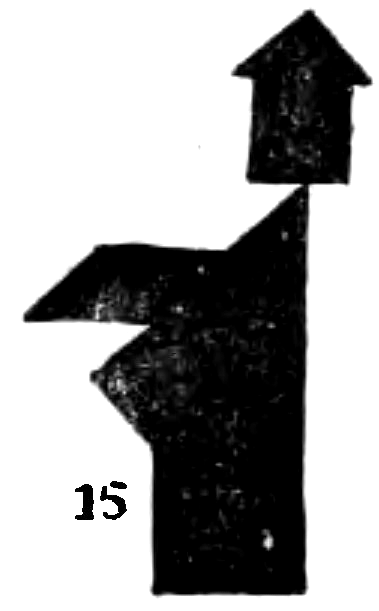
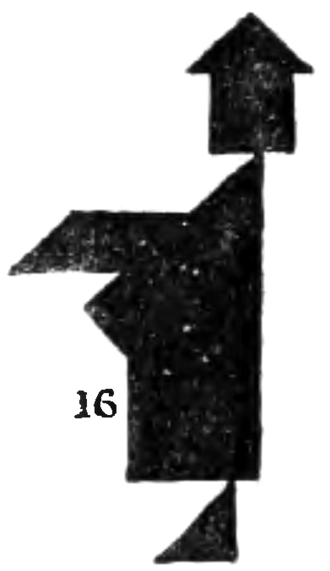
Its most famous Western champion was the puzzle writer Henry Dudeney, who popularised the tangram paradoxes: pairs of figures that appear to use the same seven pieces yet differ by a visible piece of shape. His "two monks" pair shows two apparently identical figures, one of which seems to be missing a foot. The missing area is hidden in a slightly wider body.
The tangram's cousins
The tangram is the famous one, but it is neither the only puzzle of its kind nor the first. A dissection puzzle is any set of pieces cut from one shape and rearranged into others, and the family is old, large and international. You can play some of these puzzles alongside the tangram on the all puzzles page. A few members of the family are worth knowing:
- Sei Shōnagon Chie no Ita (清少納言知恵の板, "Sei Shōnagon's board of wisdom"). Japan's own seven-piece square, printed in 1742, decades before the earliest record of the tangram, and named after the Heian court writer by tradition rather than by any evidence she had a hand in it. It cuts the same square a different way: no large triangles, but a second medium triangle and two trapezia, which lets it reach figures the tangram cannot, including a square with a square hole in the middle. It is the second set in the shape library, so you can play the Sei Shōnagon puzzles here and feel the difference.
The Sei Shōnagon set, assembled as a square - The Stomachion, or Ostomachion. Fourteen pieces cut from a square, and the oldest puzzle of this kind on record: Archimedes wrote about it in the third century BC. What is left of his text survives in the Archimedes Palimpsest, a prayer book a medieval scribe wrote over his work, which turned up at auction in 1998. He seems to have been asking how many ways the pieces fit back into the square. Bill Cutler answered that by computer in 2003: 536, if you don't count turning or flipping the whole square. It is one of the impossible tangram variations here: put the Stomachion back together.
The Stomachion, assembled as a square - The Egg of Columbus, Das Ei des Columbus. An egg cut into nine or ten pieces, depending on the maker, instead of a square into seven; the puzzle is German, and usually dated to the 1890s. The curved edges give it a stock of bird silhouettes that no straight-edged set can make, which is most of the point of it.
The Columbus egg, assembled as an egg - Polyominoes. A different family, and a useful contrast: the pieces are built from unit squares rather than cut at 45°, so they tile a grid rather than a lattice of triangles. The twelve pentominoes, named by Solomon Golomb in 1953, are the set most people meet. They are one of the impossible tangram variations here too: pack the pentominoes into their rectangle.
The twelve pentominoes, packed into a 6 × 10 rectangle
What all of them share is what makes the tangram worth playing in the first place: a small fixed set of pieces, a silhouette with no internal lines to give the answer away, and no way to tell by looking whether the shape in front of you can be made at all.
The mathematics of the tangram
The tangram has a mathematical literature of its own. The best-known result is a counting one: in 1942 Fu Traing Wang and Chuan-Chih Hsiung proved that the seven pieces can form exactly thirteen convex shapes: figures with no dents, out of the enormous number of shapes that are possible in total.
That contrast is what makes the puzzle interesting. Almost every silhouette you can draw is not a tangram: the seven pieces have fixed areas and fixed angles, so a shape must happen to decompose into them. Some silhouettes have exactly one solution; others have several; most have none at all.
This is a real problem when you make tangram worksheets, because a hand-drawn outline usually turns out to be impossible. Every puzzle on this site can be solved: each one comes with a known arrangement of the pieces that makes it.
Tangrams in the classroom
Tangrams have been a fixture of mathematics teaching for over a century, because a set of seven pieces holds a surprising amount of curriculum:
- Area and fractions. Each piece is a simple fraction of the whole square (the large triangle a quarter, the small triangle a sixteenth), so the set is a manipulative for equivalent fractions that pupils can check by stacking.
- Congruence and similarity. All five triangles are the same shape in different sizes, and the two large ones and the two small ones are exact copies.
- Transformations. Solving a silhouette is applied rotation and reflection, and the parallelogram makes the difference between the two concrete.
- Vocabulary and reasoning. Describing where a piece goes forces precise language: hypotenuse, right angle, adjacent, vertex.
For classroom use, the printable tangram PDFs include a cut-out sheet of the seven pieces, silhouettes at one, two or four per page, and a separate answer key. The how to play page is the one to hand a class that has the pieces in front of them and no idea where to start.
Frequently asked questions
How many pieces does a tangram have?
Seven: two large triangles, one medium triangle, two small triangles, one square and one parallelogram. A figure is only a proper tangram if it uses all seven.
Can you flip tangram pieces over?
Yes. Traditional rules allow pieces to be rotated and reflected. It only matters for the parallelogram, since every other piece is symmetric and its mirror image can be reached by rotating it instead.
How many tangram puzzles are there?
There is no fixed number. Thousands of figures have been published since the nineteenth century, and new ones are still being invented. Only the convex ones have been counted exactly: there are thirteen.
Is the tangram Chinese?
Yes. It was invented in China in the late eighteenth century and reached Europe and America through the China trade in the 1810s, where it became a craze.
What are the tangram pieces called?
The pieces are called tans. The Chinese name for the puzzle, qī qiǎo bǎn, means roughly "seven boards of skill".
Are there other puzzles like the tangram?
Plenty. The Japanese Sei Shōnagon Chie no Ita of 1742 cuts a square into a different seven, the Greek Stomachion cuts one into fourteen, and the nineteenth century produced commercial variants by the dozen, among them the Egg of Columbus.
Do tangram puzzles always have one solution?
No. Some silhouettes can be made in more than one way, and many plausible-looking outlines cannot be made at all. Each puzzle in the online game is generated from a known arrangement, so it always has at least one.
Sources and further reading
- Tangram on Wikipedia. Origins, the route into Europe and America, and the history of the name.
- Tangram at Wolfram MathWorld. The mathematical definition and the count of thirteen convex tangrams.
- Fu Traing Wang and Chuan-Chih Hsiung, "A Theorem on the Tangram", American Mathematical Monthly 49 (1942). The original proof that exactly thirteen convex figures exist.
- Jerry Slocum, The Tangram Book (2003). The standard history of the puzzle and its nineteenth-century craze.
- Dissection puzzle on Wikipedia. The wider family the tangram belongs to, with the Stomachion and the Egg of Columbus.
- 清少納言知恵の板 on Wikipedia. The Sei Shōnagon set and its 1742 book, in Japanese.
- Ronald C. Read, Tangrams: 330 Puzzles (Dover, 1965). A large classic collection of figures to solve.